You Are Here:
Home > Products > Robotic "MIG" Torches > Tandem Water-Cooled Torch
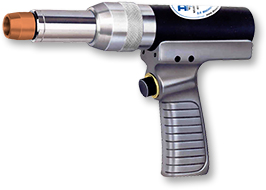
D/F Tandem Water-Cooled "MIG" Machine Torch - Remote Mount

D/F Tandem Water-Cooled "MIG" Machine Torch

The D/F Machine Specialties specially designed high amperage "MIG" Tandem welding torch is a critical component of the Tandem welding system, engineered with specific spacing and alignment of two contact tips to achieve proper arc control. The torches are usually rated in terms of combined current flowing through both wires due to the demands of high amperage, high duty cycle production runs. This rating is typically in the 600-1300 amp range. D/F's patented "MIG" Tandem Torch has been developed for heavy-duty welding, where the requirements relating to heavy-duty applications and long welding times are rigorous. The  D/F tandem welding torch is designed to provide excellent cooling of the nozzle, gas cup, body and the current tips. Two wire electrodes electrically insulated from one another must run through a common gas nozzle and share a common welding torch. Efficient cooling of the round shaped tandem gas cup prevents welding spatter easily sticking to the gas cup. The separate water-cooling of the nozzle reduces spatter and prolongs gas cup life. Because a lot of heat is generated in the tandem process it must be subsequently dissipated all the way to the front area of the contact tubes. Each body assembly is also separately water-cooled ensuring tip life and arc stability. The insulation of the two separate tandem torch inner bodies of the single common torch is done according to existing D/F standards, guaranteeing no electric flash-over between the two electric systems. The distance between the tandem contact tips (the wires) can vary by removing the body screws of one or both of the inner bodies. This allows rotation of each inner body increasing or decreasing the distance between the two welding wires. The D/F Tandem Torch inner bodies can be either straight or bent to desired degrees to help achieve different center-point distances between the two tandem contact tips and are easily changeable.

To provide maximum resistance to the abuses of day to day service, the tandem torch is of heavy duty construction with all metal parts well insulated from current carrying members. The compact in-line body allows the D/F Tandem Torch to be used in a variety of applications with ease of maneuverability and can access hard to reach areas of operation. To facilitate maneuverability, all service lines are internally connected to the tandem torch bodies and exit from the rear of the torch barrel. The tandem torch can use either threaded (HTM) contact tips or slip-in (NCM) contact tubes secured with a collet nut supplied with the torch. The contact tip can be quickly and easily replaced by unscrewing the metal nozzle and collet nut, and removing the tip. The D/F Tandem Torch, like all D/F torches, is easily reparable, thus reducing downtime and increasing productivity.

The D/F Machine Specialties Tandem Water-Cooled "MIG" Machine Torch is configured to provide individual parameter control for each of two separate, and electrically isolated, welding arcs. This requires a pairing of all equipment; two specially designed high-speed inverter power sources, two wire drives, two separate welding wire pay-off sources and a D/F Tandem welding torch.

Each D/F torch is fully assembled and ready to install. In order to make the installation complete, the code number, wire size, make/model (Lincoln wire feeders, Miller wire feeders, ESAB wire feeders), and inlet as needed must be specified when ordering. If special welding tools or accessories other than those listed previously are required, please consult with the factory. Get the Right Feeder Adapter Connection to Fit Your "MIG" Wire Feeder.

- - -

MODEL EXPLANATION

NCM-TDP - Normal Duty, Collet Action (Slip-In Current Tip), Machine Barrel - Tandem Dual Power
HTM-TDP - Heavy Duty, Threaded Current Tip, Machine Barrel - Tandem Dual Power

FEATURES:

  • High Weld Metal Deposition Rate
  • Standard D/F Utilities Used
  • Wide Range of Torch Sizes & Wire Spacing
NCM-TDP/HTM-TDP SPECIFICATIONS
Current Capacity  
  NCM-TDP
1300 amp Continuous Duty
  (combined 2x 650 amp inner bodies)
  HTM-TDP 1300 amp Continuous Duty
(combined 2x 650 amp inner bodies)
BARREL DIMENSIONS
Overall Length 14.50"
Diameter of Body Housing 2.375"
Recommended Wire Diameter Range .030 - .062" Hard
  .035" - 7/64" Cored
  3/64" - 3/32" Aluminum
Weight (approx., w/out services) 11 lbs.
Weight (approx., w/ services) 20 lbs.
Cooling Required per Inner Body
3 quarts/minute

NCM-TDP/HTM-TDP ORDERING INFORMATION - COMPLETE BARREL ONLY
Description Code No.
Model NCM-TDP Tandem W/C Machine Barrel 43300
Model HTM-TDP Tandem W/C Machine Barrel 41301

NCM-TDP ORDERING INFORMATION - COMPLETE ASSEMBLY
Description
Model NCM-TDP Tandem W/C Machine Barrel Complete with Utilities
2 Ft.
44705-2
3 Ft.
44705-3
4 Ft.
44705-4
5 Ft.
44705-5
6 Ft.
44705-6
8 Ft.
44705-8
10 Ft.
44705-10
12 Ft.
44705-12
15 Ft.
44705-15

HTM-TDP ORDERING INFORMATION - COMPLETE ASSEMBLY
Description
Model HTM-TDP Tandem W/C Machine Barrel Complete with Utilities
2 Ft.
44706-2
3 Ft.
44706-3
4 Ft.
44706-4
5 Ft.
44706-5
6 Ft.
44706-6
8 Ft.
44706-8
10 Ft.
44706-10
12 Ft.
44706-12
15 Ft.
44706-15

The Tandem Torch Welding Process

The tandem process is a GMAW automated process that increases the application range of traditional single-wire GMAW processes: Two electrically isolated wire electrodes are positioned in line, in the direction of travel. The first electrode, the 'Lead' (Mode A), controls the majority of the base plate penetration. The second electrode, the 'Follow' (Mode B), controls weld bead appearance and contour, edge wetting, and adding to the overall deposit rate. The spacing between the two wires is usually less than 15mm so that both welding arcs are delivering to a common weld puddle, but can be adjusted for job requirements and different applications. The process uses a true tandem configuration of dual power sources and two wire feeders to generate two separate welding arcs. The output of the two power sources are coordinated by either a robot controller for robotic applications, or by a Tandem interface for dedicated hard automated work cells. The two arcs are positioned to operate in a common weld puddle by a specially designed high amperage D/F Machine Specialties patented Tandem Water-Cooled "MIG" welding torch. Operation of the welding arcs in the close proximity of a common weld puddle is made possible by the use of high-speed dual power source output coordinating the interaction of the welding arcs. This unique operating arrangement promotes productivity, often greater than two separate wire electrodes, while providing the operating convenience of a single torch process.

The tandem process establishes a means for increasing both the travel speed and deposition rate without compromising the weld quality. The ability of the process to control heat input and bead wetting further enhances weld quality and minimizes weld repair associated with burn-through on thin components, or distortion on thick members. The process works best with a large diameter 'Lead' (Mode A) wire and a small diameter 'Follow' (Mode B) wire. The larger 'Lead' wire may represent as much as 65% of the total deposition rate, while providing greater penetration. The smaller, trail welding wire is focused on the trail edge of the weld puddle. The trail wire is typically smaller in diameter and therefore draws less current. This helps to control the shared weld puddle and aids in keeping it cool. A common compromise is to specify the 'Lead' and 'Follow' welding wires to be the same diameter to satisfy inventory constraints or because the direction of welding must be reversed somewhere on the weldment.

The Most Common Variants of the Tandem Process:

  1. Pulsed/Standard mode: 'Lead' (Mode A) arc is synchronized pulsed while the 'Follow' (Mode B) arc is Constant Voltage for achieving maximum welding speed and gap bridging.
  2. Standard/Pulsed mode: Best for deep penetration the 'Lead' (Mode A) arc is in Constant Voltage mode which maximizes penetration and travel speed while the 'Follow' (Mode B) arc is in pulse mode to reduce heat input and cool the weld puddle.
  3. Standard/Standard mode: 'Lead' (Mode A) and 'Follow' (Mode B) arcs are both in Constant Voltage mode usually for welding with just one electrode and switching to the other when changing directions to reduce cycle time.

Benefits

  • Maximum deposition efficiency (40% to 80% increase over single-wire)
  • Doubles production speed or better
  • Direction of process is independent
  • Have capability to track in either direction with either wire ('Lead' or 'Follow') for maximum flexibility with creating programs and doing off-line programming.
  • Allows full advantage of robots working range.
  • Capable of tracking off either wire
  • Lowers production costs
  • Increases productivity

Advantages

  • High welding speeds
  • Faster cycle times
  • Reduced heat input
  • Resists burn-through on thin materials
  • Low spatter levels
  • Good penetration on thick materials

Typical Applications
The tandem process is typically used on cylinders, tanks, water heaters, lawn and garden equipment, gussets and stiffeners, off-road equipment, construction equipment and agricultural machinery, ASME tanks, joggle joints, and pipe and tubular components.

Power Sources
Tandem-Wire welding made substantial advances when power sources were converted to digital technology. Now it was possible to control the welding process in a completely digital manner, which yielded considerable benefits:

  • Small and compact electronics.
  • Flexible system control of the welding arc
  • Long term stability not affected by temperature drifts

It was vital that the two power sources communicate with each other for the synchronization of the two electric arcs. An additional requirement was that the robot could activate the two power sources as a single power source.

Wire Feeders
Advancing two welding wire electrodes requires two wire feeder mechanisms that each advance one electrode. In the automated process it's important that the wire feeders are capable of unwinding wire from large drum coils in a manner that also straightens the wire.

In conclusion, for all applications a substantial increase in productivity can be obtained. The rule of thumb sometimes mentioned, "double-wire = double speed", appears to be correct compared with conventional single-wire welding. The welding speed, the weld quality and the process tolerances must however be balanced (evaluated for each case). It is also interesting to note that the tandem welding process has a much higher penetration capacity than single-wire welding. D/F's Tandem torch, will help reach maximum output of the welding process by increased weld speeds, increased arc stability for optimum weld quality and consistency, higher deposition, and Maximum number of hours of welding contact/current tip life, thus reducing shut downs and start ups also reducing the amount of scrap produced.

 
D/F® is the registered trademark of D/F Machine Specialties, Inc. Lincoln Electric, Miller Welding, ESAB and other "MIG" & "TIG" welding manufacturers mentioned are for reference only and are the registered trademarks of their respective companies. D/F Machine Specialties, Inc. is not affiliated with these other companies.

Follow D/F:

D/F Machine Specialties on Facebook D/F Machine Specialties on MySpace D/F Machine Specialties on Twitter D/F Machine Specialties on Flickr D/F Machine Specialties on Youtube
